Wednesday, February 23, 2011

SERMON: God Loves His Enemies

Date: February 20, 2011
Sermon Text: Matthew 5:38-48

[Introduction] When I was growing up, Gary Larson created the comic strip The Far Side. In the strip, God was a recurring character. Larson often depicted God as a big man with blue-tinted skin, a white unibrow, and bushy white beard. One of Larson’s particularly popular depictions of God is called “God at his computer.” In the picture, God is sitting at his desk, idly watching his computer screen. On the screen, a man is walking obliviously down the side-walk. I say “obliviously” because there is a falling piano inches above his head! But, God looks on undisturbed, his finger hovering over a big white button on his keyboard marked, simply, “Smite.”

God sitting at his computer, bored, waiting for someone to slip up so he can hit the smite button – that’s a way a lot of people think about God. Some theologians have said that everything we say about God is just us casting our own images against the sky and calling that self-reflection “God.” In this case, I think they’re right. God, bored at his computer, smiting people as a form of amusement – that probably says more about us than it does about God. Our Gospel passage today illumines just that

[Page 1] Jesus sits atop a mountain in Galilee teaching his disciples, having just escaped the crowd. He had been among the people healing, teaching in synagogues, and driving out demons. But in our passage, he has withdrawn, coming up out of the crowd, and the disciples gather around him. He teaches what later will be called the Sermon on the Mount. The disciples are the primary audience. The crowd gathers below

As the disciples sit and the crowd strains to hear, Jesus repeats the Scripture to them: “You have heard that it was said, ‘An eye for an eye and a tooth for a tooth’.” Again, later, “You have heard that it was said, ‘You shall love your neighbour and hate your enemy’.” That last bit about hating the enemy wasn’t in the Jewish Scriptures, but it was apparently something the disciples and the crowd had already heard. Jesus and his audience live in a world where it is natural, even expected, to hate your enemy

And Jesus’ audience has many enemies. The crowd shifts uncomfortably as a group of Roman soldiers passes nearby. It’s better to keep your eyes down than earn the wrath of those non-Jews, the “Gentiles,” who oppress them and laugh in derision at Israel’s faith in the one, true God. Perhaps worse than the soldiers at the edge of the crowd are the Jewish people who aren’t there, their own people who sell themselves out to the Romans as tax collectors. The collectors are seen as the worst of the worst, preying on their own for the benefit of the enemy. It is no wonder that both before and after Jesus’ ministry, great numbers of Jewish people rose up in revolt against Rome and felt justified doing so. Their very way of life was under attack. Hating your enemy – returning an eye for an eye and a tooth for a tooth, striking when struck, protecting one’s assets from those who would steal them by hook or by crook – this was the only way to survive. In other words, protect yourself; look out for what’s yours; and hate the one who wants to take it from you. For Jesus’ disciples and the crowd below, this is the way the world works. Watch out for yourself; hate your enemy. Enemy-hatred is the name of the game.

[Page 2] In the 21st century, in an age of democratic government and religious tolerance, it is easy to think that this human dynamic has changed. If we acknowledge having enemies, they are often far away, speakers of other languages, followers of violent forms of religion. But, we too are like the people in Jesus’ day. We too have enemies that make us want to watch out only for ourselves and lash out against any threat, like a snake coiled tightly around its eggs.

We keep enemies in our personal relationships. We refuse to deal with conflicts as they arise, and the inconvenience quickly turns to annoyance which festers into disgust and bleeds hate. We make foes of those who should be our friends. We tell nasty stories about them to ourselves and to anyone who will listen. Or, we bottle the stories up and let them ferment until we cannot hold them any longer, and we explode.

It’s been said that the average inmate serving time in American prisons for crimes like theft, drugs, etc. has six convictions. Most are not there because they were hungry and stole something to survive. Most are the product of brutal streets full of the enemy-hatred that we think of when we first think of an “eye for an eye and a tooth for a tooth.” But, whereas the average inmate has six convictions, there is a special class of inmate that on average has only one. They are the murderers. Most often, they commit crimes of passion driven by anger, oftentimes anger that has festered against a loved one for years. It festers until one day they snap, and they kill. This statistic alone shows Jesus to be very wise: he said in our reading last week that to hate your neighbour was to commit murder. They are not so far apart after all.

But it also goes to show that even in today’s world, we all harbor enemies, even though we often call them friends. We nurse our hatreds with our neighbours and let them grow. Enemy-hatred, even if we do a good job masking it, is still the name of the game, and because of that it is no wonder that Larson’s cartoon of God at his computer resonates so deeply with us. We all know a few people we would like to drop pianos on. If God were like us, then God would be just like Larson depicted.

[Page 3] But, thanks be to God, God is not like us at all. On the mount, Jesus says to his disciples and the listening crowd, “You have heard it was said, ‘You shall love your neighbour and hate your enemy.’ But I say to you, Love your enemies and pray for those who persecute you.” Why does Jesus want his disciples to love and pray for their enemies? Jesus continues: “Love your enemies and pray for those who persecute you so that you may be children of your Father in heaven.” What does loving enemies have to do with being God’s children? Jesus explains: “for he makes his sun rise on the evil and on the good, and sends rain on the righteous and on the unrighteous.” In other words, quite unlike the God Larson depicts, and quite unlike the enemy-hating world in which the disciples live, God loves his enemies, and he shows his love by making the sun rise on everyone, the good and the bad, and by sending the rain on the good and the bad alike. Jesus concludes by saying, “Be perfect, therefore, as your heavenly Father is perfect.” Human perfection, Jesus seems to be saying, is nothing other than loving your enemy because God loves his enemies.

In the Gospel of Matthew, this is the first time the disciples gather around Jesus to receive a special teaching. What they won’t realize until much later is that everything that Jesus demands of them in this portion of the Sermon on the Mount is what he himself is doing. Jesus is the one who turns the other cheek when on trial before the Sanhedrin. Jesus is the one gets sued for his coat and gives his cloak as well to be divided among the Roman guards. Jesus is the one who walks the second mile with his cross to the mount of Golgotha. Jesus is the one who gives of himself until the very end of his being, to whoever asks. Jesus is setting the stage here so that his disciples can later realize that God is loving his enemies through what Jesus does in his life. St. Paul will later exclaim, “For if, while we were God’s enemies, we were reconciled to God through the death of his Son, how much more, having been reconciled, shall we be saved through his life!” (Ro. 5:10). Jesus’ earthly life is itself the supreme act of God’s enemy-love, a love which will change everything.

[Page 4] Unlike the disciples in our passage, we have the advantage of hindsight. We can see that God’s love for his enemies culminated in Jesus’ death and resurrection. We can see that the Church has been the place where people gather to learn how to replace their enemy-hatred with love. We can see that through this enemy-love, the powers of this world have been brought low as the Church imitates Jesus, the author and perfecter of our faith.

What does it mean to love our enemies? In the first place, it means that we have to acknowledge that we have enemies, not just enemies far away, but enemies in our homes, our workplaces, even here at St. Matthew’s. We all have enemies, people who have it out for us, or people we have it out for. Loving our enemies first means acknowledging that we have them.

Second, Jesus says to “love your enemies and pray for those who persecute you.” After acknowledging that you have enemies in your life, the next thing to do is pray for them. We might in moments of anger pray that God drop a piano on their heads, and really it’s okay to pray that from time to time. But, if we want to follow Jesus, we have to find ways beyond that vengeance-dream to actually praying for our enemies’ good. This is hard for us, perhaps impossible on our own. But remember that Jesus himself took God’s love for his enemies to its furthest extent – to the point of death. Because Jesus prayed for his enemies with his whole life and prays for his enemies now at the Father’s right hand, we have hope and power. We can pray for our enemies now, too.

Third, from a place of prayer for our enemies, we can learn to uncoil a bit, to relax, to actually be human with the people we are struggling not to hate. From this place of freedom in the enemy-loving God, we are free to turn the other cheek, to give extravagantly, to walk the second mile, to start the journey of perfection that will end with the world restored in the glory of God.

I was told this week that like the Riverdale neighborhood St. Matthew’s has a fighting spirit. We don’t give up when things get tough. We redouble our efforts. What Jesus makes clear today is that we are called to identify and fight our enemies not with violence but with prayer and reconciling service. This is a hard and high calling. Let us embrace it, not giving up but redoubling our efforts to turn our nearby enemies into reconciled neighbours. For God so loved the world that while we were still his enemies, he sent Christ to save us. In response to God’s amazing grace, as our worship continues let us pray for our enemies, come forward to receive God’s reconciling love with our hands, our mouths, and our hearts, and go forth in peace to love and serve the Lord among our neighbours yes, but also, and especially, among our enemies.

In the name of the Father and of the Son and of the Holy Spirit. Amen.

Wednesday, February 09, 2011

Synod for Communion Partner–ACNA Reconciliation

On the Covenant blog, Phillip Anderas has posted a sermon entitled "And None But Thee." Intriguingly, the sermon has this enigmatic explanatory note attached: "A Sermon to Be Preached at the Synod for Communion Partner–ACNA Reconciliation."

I am from a Communion Partner diocese. My home parish went through an AMiA split a couple of years before I started attending there. I have dear friends who attend that now-ACNA parish and are entering discernment for Holy Orders. The division among orthodox Anglicans has been a sticking point between us. To say the least it is painful.

Anderas' sermon is about repentance and reconciliation. A paragraph near the conclusion reads:
It may be that the splinters of this broken bridge will sink deeply into the holy water of baptism, and we Anglicans will find that God in his mercy has killed us only to make us alive. If he first devours us, the great Lion of the tribe Judah may not, after all, spit us out of his mouth. There is a sharp, double-edged sword that comes out from that mouth, a living and active Word; and the Lord will use it to strike down the nations. If he slays us now, he will bring us to life. If he brings us down to Sheol, he will raise us up from the dead. If he makes us poor, he will enrich us. If he brings us low, he will exalt us. He will raise up the poor from the dust and the needy from the ash heap and make them sit with princes, with the princes of his people.
Needless to say, I was intrigued by this thought. Was there really a Synod meeting somewhere in secret, perhaps a convocation of Communion Partner and ACNA bishops, committing themselves to find common cause again in the Gospel? When would the results of such a convocation be announced? What might that mean for me and my ecclesially-separated friends?

But, after Google searches and emails to knowledgeable colleagues, I found that, to the best of our knowledge, no convocation exists or is planned to exist. What a desperately sad realization after that initial burst of hoping for Spirit-wrought and institutionally meaningful reconciliation between our churches.

But, then again, there was that burst of hope. And that makes me wonder: is there something here? If Covenant created an imaginary synod that exploded to life in my mind, did it awaken forgotten hope in others as well? Might there be a place for such a gathering, such a convocation, such a holy assembly?

I pray there is, by God's grace.

Monday, November 22, 2010

SERMON: Christ the King

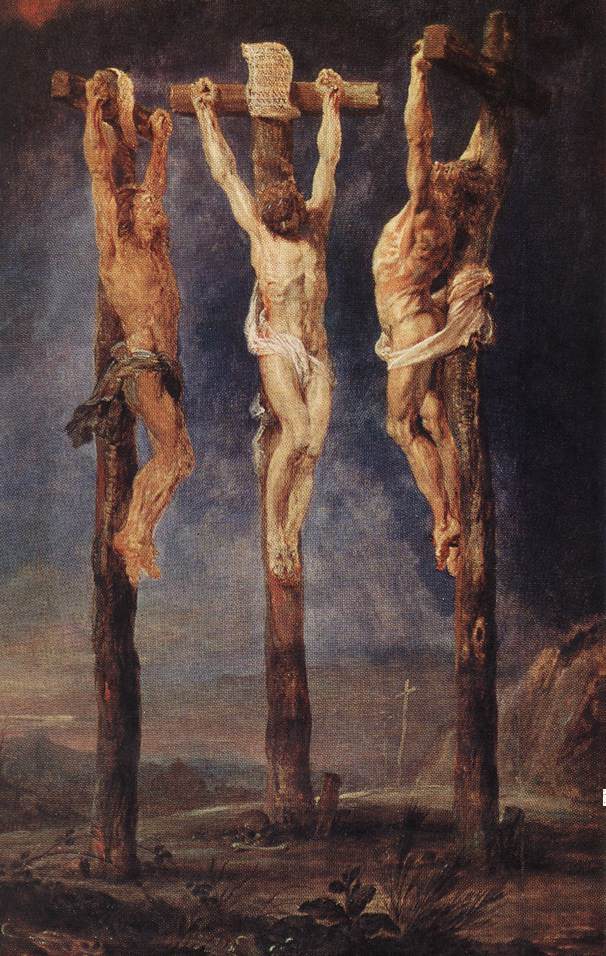
The Three Crosses
by Pieter Pauwel Rubens (1620)
Date: November 21, 2010
Sermon Texts: Jeremiah 23:1-6; Colossians 1:11-20; Luke 23:33-43


Let us pray. May the words of my mouth and the meditations of all our hearts be acceptable in your sight, O Lord, our strength and our redeemer. Amen.


[Introduction] Today we celebrate the final Sunday of the liturgical year: Christ the King Sunday. Next Sunday is the first Sunday of Advent. A week from today, Christians will be able to say to one another, “Happy New Year!” and mean it. We Christians have our own calendar and celebrate our own feasts as a way of expressing the world’s deepest truth: Christ really is the King. He is king not only of our lives but of the whole world.


[Page 1] Turning to our readings today, we can see that this idea that Jesus is king is not what the world thought. Our passage from Luke’s Gospel begins with the clang, clang, clang of stakes being driven into wooden beams. The text says, “When they came to the place that is called The Skull, they crucified Jesus there with the criminals, one on his right and one on his left” (Lk 23:33). As Jesus hangs naked on the cross with a crown of thorns on his head, those who crucified him stand around. They are the leaders of Jesus’ world. On the one side, there are the religious leaders of his nation. They, the shepherds of God’s people, scoff at Jesus: “He saved others; let him save himself if he is the Messiah of God, his chosen one!” On the other side, there are the Roman soldiers. They, too, mock the bleeding Jesus: “If you are the King of the Jews, save yourself!” Even one of the criminals hanging beside Jesus derides the broken man: “Are you not the Messiah? Save yourself and us!” And, even though the sign above Jesus’ head reads “This is the King of the Jews,” there is no doubt in the gathered crowds’ minds that he is no such thing. The whole world is gathered around Jesus on the cross. From the lowest criminal to the highest religious and political authorities in Jesus’ world, the whole world rejects Jesus as king.


Saturday, November 13, 2010

George Bailey is Trapped

On Wednesday nights, I host a movie discussion group at Grace Church-on-the-Hill.  The current five-week series focuses on the question, "What is the meaning of life?"  We're watching five films that touch on the topic.

Last night, we watched It's a Wonderful Life.  More than a decade has passed since I last saw the film.  As I prepared for the night and discussed the movie with the group, I realized that Life is a very adult movie.  The week prior, we had watched The Truman Show.  There are some striking parallels between the movies, but in comparison Truman is a teenage movie.  Here's why.

George Bailey is trapped.

Sunday, October 17, 2010

SERMON: God, Faith, Service

A mulberry tree

Date: October 3, 2010
Sermon Text: Luke 17:5-10

Let us pray. May the words of my mouth and the meditations of all our hearts be acceptable in your sight, O Lord, our strength and our redeemer. Amen. 

[Introduction] Our Gospel lesson this morning is about faith and miracles. When I think about faith and miracles, my mind always jumps immediately to the so-called “faith healers” that can be seen on Sunday morning television. One famous faith healer, whose name we’ll change to “Rev. James,” proclaims that God has given him the gift of healing, and when he prays for someone, they often fall over unconscious, overwhelmed by the experience. They are “slain in the Spirit.” I don’t doubt the sincerity of these actions. I myself have experienced, in instances of intense personal and corporate prayer, extreme vertigo. But the whole scenario certainly raises some questions about faith for me.

And the questions are only exacerbated when a seminary friend of mine, who knows of my deep and abiding love of Star Wars, sends me doctored YouTube videos. This video he sent me took clips of Rev. James slaying people in the Spirit and combined it with the moving battle music from the Star Wars films. And, to top it off, the clever video editors put a glowing red lightsaber in Rev. James’ hands. In each of the original clips, Rev. James swings his arms at the people to slay them in the Spirit, but in the edited version, he’s knocking individuals and groups over with one swing of his lightsaber. “Rev. James,” the video proclaims, “Dark Lord of the Sith.”

Monday, September 20, 2010

Sermon: The Cup of Discipleship

Date: September 5, 2010
Sermon Text: Luke 14:25-33


Let us pray. May the words of my mouth and the meditations of all our hearts be acceptable in your sight, O Lord, our strength and our redeemer.


[Introduction] The liturgy of our church is a scary thing. For some of us who have come to Anglicanism later in life, it is scary because it is new. The words sound funny on our tongues. We’re not sure where to pause during the Nicene Creed. We often speak out of turn. For those of you who grew up with the liturgy, it might be scary because it is so familiar. It could be that whole worship services go by without the words penetrating the haze of the busy-ness of our weeks. But for both old and new, the liturgy is a frightful thing for a quite different reason. Every week, the liturgy tricks us. It tricks us into saying words that commit us once again to the life of discipleship. It prompts us to reaffirm our baptismal vows. It calls us out of ourselves into a new kind of life. But it does all this without often asking us to count the cost.

Saturday, August 21, 2010

Tim Jones+: A Chink in the Curtains

My friend Tim Jones+ recently posted this at his blog, Life-Changing Prayer and has given permission for its reposting here. Where do you find the chinks?


A CHINK IN THE CURTAINS

I was reading along, not expecting to find a startling spiritual image in a twentieth-century novel by a writer not exactly known for his praying.

But W. Somerset Maugham’s character, Larry, the aimless and likeable protagonist in The Razor’s Edge, is recounting the chats he had with a hulking uncouth Polish miner. It turns out that Kosti (a simplified Polish name for the unlikely spiritual guide) had a secret love of spiritual writers (indeed, the man only had the courage to reveal his hidden longings when drunk). He ends up being a kind of spiritual mentor to Larry.
“It was all new to me and I was confused and excited,” Larry told a friend of his conversations with Kosti. And what Larry said next was what struck me: “I was like someone who’s lain awake in a darkened room and suddenly a chink of light shoots through the curtains and he knows he only has to draw them and there the country will be spread before him in a glory of the dawn.”
I wonder what that image meant to Maugham, the author. Certainly something, sometime had felt to him like at least a glimmer or a glimpse: “A chink of light shoots through the curtains.”
And to know that to draw the curtains means seeing a “country … spread out before [us] in a glory of the dawn!” I wonder what intimations he had of the spiritual possibilities.
I know that I can go along, not expecting much, not staying much on the lookout, but then I come awake, maybe for just an instant or so, to a world just out of view, one with a spreading glory, just beyond the curtains of everyday occupations.
No wonder Paul spoke in Ephesians 3:18-19 of how he hoped those hearing him would “have strength to comprehend with all the saints what is the breadth and length and height and depth, and to know the love of Christ that surpasses knowledge.”
That glory seems to appear to us sometimes through a chink or in a corner or crevice. But sometimes I have the wherewithal to wonder what more lies beyond the glimmer. I might even go looking.

Wednesday, August 18, 2010

Sermon on the Feast Day of St. Mary the Virgin

Date: August 15, 2010
Sermon Texts: Isaiah 7:10-15; Galatians 4:4-7; Luke 1:46-55


Let us pray: May the words of my mouth and the meditations of all our hearts be acceptable in you sight, O Lord, our strength and our redeemer.

Someone asked me this week what success looked like.  We had a good, long conversation about it.  For as long and good as it was, it was still far too short.  I confess that I brought the question into my office with me as I started preparing this sermon.  What does success look like?  What does it mean to be successful?  There are, of course, a lot of different answers to that question, all of which depend on a person’s situation and perspective.  But, in today’s readings, as we celebrate and remember St. Mary the Virgin, I think we have the beginnings of a Christian answer to the question.

Sermon: Jesus Makes Space at His Feet

Date: July 18, 2010
Sermon Text: Luke 10:38-42

Last week, the Gospel passage ended with Jesus’ command, “Go and do likewise.”  In the parable of the Good Samaritan, I said that the lawyer (and we) should see ourselves, in the first instance, as the man beaten and left in the ditch to die, and I encouraged us to hold our hand open to let God rescue us.  I should say, now, that only the first foot dropped last week.  In the first instance, we are to recognize that we are in need of God’s rescue.  The second foot is what Jesus says at the end of the parable: “Go and do likewise.”  Go and rescue others from their ditches.  Go bring people back to Jesus and His Church.

Our Gospel passage today falls right on the heels of Jesus’ “Go and do likewise.”  St. Luke tells the story of someone who heard the “Go and do” and took it too seriously and too far.  This is Martha.

Sermon: The Good Samaritan

This is the first sermon I preached at my new parish home, St. Matthew's Riverdale.


Date: July 11, 2010
Sermon Text:
Luke 10:25-37

It wasn’t too long ago, when I was in high school. And I was in love. There was a girl in my church’s youth group who seemed to me, at the time, to be everything I could have ever wanted.


I remember trying to get this girl just to like me back. I didn’t know what to do. Nothing seemed to work. I talked to people. I even read a best-selling Christian book on high school dating. After months of frustration, sitting at the kitchen table, I finally blurted out to my mother: “I don’t understand. What I have done wrong? I’ve done everything right. And it’s not working out!” My mother did what good mother’s do and gave me a hug. But, the unspoken question lay there on the table: “Really, what do I have to do to make her love me?


Contra Factum - out of retirement

It's been long, too long, since I've posted here at Contra Factum. I intend to rectify that as I clean up the remnants of old blogs around the web. Soon, this will be the one-stop shop for all things Jason, including sermons, photos, news stories, etc.

Saturday, June 20, 2009

What’s Wrong with Theology: A Short Case Study

Over at Mode of Expression, Jeff Reimer recently posted What’s Wrong with Theology: A Short Case Study in which he describes his interaction with a recent edition of Augustine's sermons. It's worth the read.

An excerpt:
One of the maddening things about my “Christian spirituality” classes in grad school was the constant separation students fretted over between “head” and “heart.” This may have been a legitimate problem, but the way they articulated it made it sound like the problem was somehow too much theology. Wrong! A bifurcation of “head” and “heart” is the result of faulty theology, not too much. Something we could learn by reading more Augustine.

Friday, June 19, 2009

New Review Up

Over at the Princeton Seminary Library page, a new book review from yours truly is up: Joe Mangina's Karl Barth: Theologian of Christian Witness. Enjoy!

Tuesday, June 16, 2009

Sermon: Jesus Sends Doubters

Last weekend, I was in New Jersey and preached at Montgomery Evangelical Free Church, the church where Monique and I attended and I worked during seminary. It has been my tradition to post the full text of my sermons along with the audio when it is available.

The audio may be found here.

Full text below:
---
"Jesus Sends Doubters"
Matthew 28:16-20
[Open with prayer]
Please turn in your Bibles to Matthew 28. Let’s start in verse 16: “Then the eleven disciples went to Galilee, to the mountain where Jesus had told them to go.” We need to back up and get some context. Earlier in Matthew 28, Mary Magdalene and the other Mary went to Jesus’ tomb. There they witnessed a violent earthquake, the descent of an angel, the fainting of the guards, and as they were going away from the tomb, they ran into Jesus himself. They took his instruction to the disciples: “Go and tell my brothers to go to Galilee; there they will see me.” And quickly they departed. At the beginning of the passage today the eleven remaining disciples are climbing the mountain to find Jesus.
Did some of the disciples’ faces radiate joy? Did others radiate hope? Did others mix the two, like the women in verse eight, who were “afraid yet filled with joy?” As the eleven climbed the mountain, each one knew that something was going to happen, even if that something was nothing at all.

Saturday, February 28, 2009

Per Caritatem: Paul and Slavery

The Per Caritatem blog has just started a series called "Paul and Slavery: Submit, Subvert, or Something in Between?"  The first post is very engaging, and I'm looking forward to the rest.  I hope you'll check it out.

Friday, September 26, 2008

Auctioning Virginity

This is from IvyJungle.org:

Graduate Student Auctions Off Virginity:  In a new low for morals and capitalism, a 22 year old graduate student at Sacramento State has joined with a legal Nevada brothel to auction off her virginity.  The young woman says she can verify her purity and is selling her first experience to finance her graduate education in marriage and family therapy.  Holding an undergraduate degree in women's studies she believes her actions are empowering to her as a woman and that her virginity is marketable because it is a rare commodity.  Several students have expressed support, especially for a cause as noble as paying for school.  (CBS13.com September 11, 2008)

Friday, August 15, 2008

Getting mentioned...

Because of the recent work I've been doing with Matt Jenson's The Gravity of Sin, I've gotten some exposure at the T&T Clark blog here and here. Enjoy!

Monday, August 11, 2008

N. T. Wright on the Ascension

I've been reading N. T. Wright's Surprised by Hope. Here are a couple of fantastic paragraphs on the ascension (112-113).

What happens when you downplay or ignore the ascension [or the resurrected and still embodied Jesus]? The answer is that the church expands to fill the vaccuum. If Jesus is more or less identical with the church - if, that is, talk about Jesus can be reduced to talk about his presence within his people rather than his standing over against them and addressing them from elsewhere as their Lord, then we have created a high road to the worst kind of triumphalism. This indeed is what twentieth-century English liberalism always tended toward: by compromising with rationalism and trying to maintain that talk of the ascension is really talk about Jesus being with us everywhere, the church effectively presented itself (with its structures and hierarchy, its customs and quirks) instead of presenting Jesus as its Lord and itself as the world's servant, as Paul puts it. And the other side of triumphalism is of course despair. If you put all your eggs into the church-equals-Jesus basket, what are you left with when, as Paul says in the same passage, we ourselves are found to be cracked earthenware vessels?

If the church identifies its structures, its leadership, its liturgy, its buildings, or anything else with its Lord - and that's what happens if you ignore the ascension or turn it into another way of talking about the Spirit - what do you get? You get, on the one hand, what Shakespeare called "the insolence of office" and, on the other hand, the despair of late middle age, as people realize it doesn't work. (I see this all too frequently among those who bought heavily into the soggy rationalism of the 1950s and 1960s.) Only when we grasp firmly that the church is not Jesus and Jesus is not the church - when we grasp, in other words, the truth of the ascension, that the one who is indeed present with us by the Spirit is also the Lord who is strangely absent, strangely other, strangely different from us and over against us, the one who tells Mary Magdalene not to cling to him - only then are we rescued from both hollow triumphalism and shallow despair.

There is more fantastic material in the following paragraphs, but this little tidbit hit me on Saturday when I was reading it. Wright goes on to make the interesting (and necessary point) that a human being (Jesus as the divine-human person) is running the cosmos right now from heaven - that Jesus continues his human work straight into the present. You hear these things so little - how wonderful to hear them again!

Friday, August 08, 2008

"At the Name of Jesus"

This is a lyric of a song we sing at St. Bartholomew's from time to time. The words were penned by Caroline Maria Noel in 1870, and the hymn tune we use was arranged by our music director Eric Wyse in 2005. In my humble opinion, there's not a more perfect expression of theology and piety than this song. The two verses in brackets are original, but we don't use in church, for length's sake, but they are beautiful nonetheless.

At the Name of Jesus
At the Name of Jesus, every knee shall bow,
Every tongue confess Him King of glory now;
’Tis the Father’s pleasure we should call Him Lord,
Who from the beginning was the mighty Word.

[Mighty and mysterious in the highest height,
God from everlasting, very light of light:
In the Father’s bosom with the spirit blest,
Love, in love eternal, rest, in perfect rest.

At His voice creation sprang at once to sight,
All the angel faces, all the hosts of light,
Thrones and dominations, stars upon their way,
All the heavenly orders, in their great array.]

Humbled for a season, to receive a name
From the lips of sinners unto whom He came,
Faithfully He bore it, spotless to the last,
Brought it back victorious when from death He passed.

Bore it up triumphant with its human light,
Through all ranks of creatures, to the central height,
To the throne of Godhead, to the Father’s breast;
Filled it with the glory of that perfect rest.

Name Him, Christians, name Him, with love strong as death
But with awe and wonder, and with bated breath!
He is God the Savior, He is Christ the Lord,
Ever to be worshipped, trusted and adored.

In your hearts enthrone Him; there let Him subdue
All that is not holy, all that is not true;
Crown Him as your Captain in temptation’s hour;
Let His will enfold you in its light and power.

Christians, this Lord Jesus shall return again,
With His Father’s glory, with His angel train;
For all wreaths of empire meet upon His brow,
And our hearts confess Him King of glory now.

Wednesday, August 06, 2008

The same mistake

In other words, liberalism is, simply, the desire to be taken seriously by the academy and the willingness to find an apologetic that is relevant to the culture.
Several days ago, a friend replied to my 'bad, bad windows' rant. You can see his response here. I replied, and the above sentence is part of the response. The more I think about this sentence, the more I think it is both desperately hard and true.

It is hard because I work for InterVarsity's Graduate and Faculty Ministries. We're about the work of helping Christian grad students make it in the contemporary university and, on top of that, helping them to thrive as Christians and academics, as whole people, as world-changers.

It is hard because our modus operandi is sometimes for some of us driven by wanting to be taken seriously and wanting to find an apologetic that is relevant to the academic culture.

We want to be taken seriously. Who wants to be thought of as a buffoon? Who wants to think other people are thinking one is a supersititous, backwoods idiot?

And so, we want to be relevant. We want to find a bridge between the culture that we want to take us seriously, and the message we want to bring to that culture.

But, unfortunately, the sentence remains devastatingly true - at least of the thumbnail sketch of the development of continental liberalism I was taught. Schleiermacher wrote a book on Christianity to "his cultured despisers." A brilliant thinker, he bridged the gap. He developed a sophisticated, elegant, and convincing apologetic for the Gospel.

But, in so doing, he tamed the Gospel; he broke her back. The Gospel became a maidservant to the ideology to which she had been wedded. She was eventually eviscerated of her vital life and left as a shell into which people cast their images of God against the sky.

He wanted the Gospel to be taken seriously by the culture.

He was willing to fashion an apologetic to make it so.

And us evangelicals are perilously close to the same mistake, which is why I continued in my comment:
Well, those two things sound like most evangelicals, don't they? That's because we're only ever a hair's breadth away from making the same mistake as the continental liberals: wanting more desperately to speak TO our cultured despisers than ABOUT Jesus Christ.
We ministers have to be able to speak about Jesus Christ, even at the expense of looking foolish to our counterparts and colleagues. He is public truth, and his Revelation is knowledge, but if we ever put the cart before the horse, if we ever allow something else to become the subject of the sentence, then we have already capitulated, already lost the fight. One hundred years from now, "public truth" and "knowledge" will not be the terms in which we try to cast our faith, but He will always be its purpose, content, and goal. We are speaking about him to our cultured despisers. And may it always come in that order.