Wednesday, January 31, 2007

Can a divorcee get remarried? Divorce and Remarriage in the Church, by David Instone-Brewer


Divorce And Remarriage in the Church: Biblical Solutions for Pastoral Realities

Can a divorcee get remarried? David Instone-Brewer says "yes," so long as the divorce is valid. He argues for four biblical grounds of divorce: adultery, abandonment, abuse, and neglect.

I grew up in a community in which there was only one ground for divorce: "sexual immorality," or adultery. How does Instone-Brewer get from one ground to four? The answer is relatively simple, he rigorously applies principles of biblical exegesis to the relevant passages of Scripture, and along with a few new insights into the ancient Near-East, weaves a powerful and convincing story of the four biblical grounds for divorce.

Here are some interesting tidbits. Did you know that we've found divorce certificates from the ancient Near-East? These are the divorce certificates allowed by Moses in Deuteronomy. Surprisingly, they all say (for hundreds and hundreds of years right up to ones we've found at Masada that date to after Jesus' ministry) that the divorcee has the legal right to remarry anyone she (or he) wishes. There was this problem in the ancient world that Moses solved by allowing women to have certificates of divorce. The problem was that before Moses, men could abandon their wives and still have the legal right to return years later to reclaim their wives and their children. Needless to say, this made it difficult for an abandoned woman to get remarried! Who in their right mind would marry a woman who at any point could be picked up by the absentee husband!?

Enter the certificate of divorce, which finalizes the end of the marriage and gives the woman the right to remarry anyone she wishes. According to this, divorcees could get remarried. In fact, remarriage was the point of divorce. Instone-Brewer goes on to show that this understanding of divorce is overturned neither by Jesus nor Paul.

Other interesting points:
  1. Marriage was considered compulsory in first century Judaism. Even the crazy ascetic Jews who lived in the dessert married for five years or so in order to fulfill the command to "Be fruitful and multiply." Jesus, by his teaching in the Gospels, shows that marriage is no longer compulsory when one gives up marriage for the cause of the Kingdom of God.
  2. Exodus 21:10-11 is a piece of case law that allows a wife to exit a marriage if her husband denies her "food, clothing, or conjugal love."
  3. A Jewish rabbi named Hillel came up with a novel interpretation of the divorce passage in Deuteronomy 24:1, claiming that divorce had two grounds: sexual immorality and "Any Cause." He and his students were opposed by the rabbi Shammai and his students, who claimed that Deuteronomy 24:1 only had sexual immorality in mind.
  4. Both the Hillelites and the Shammaites believed in the Exodus 21:10-11 provisions for divorce because of abuse and neglect. They just argued about how much sex a husband owed his wife in order to keep his vow!
  5. In the passages in the Gospels, Jesus is being asked to comment on the fight between the students of Hillel and the students of Shammai. "Is it lawful for a man to divorce his wife for 'Any Cause'?" Not only does Jesus side with Shammai on the interpretation of Deut. 24:1, he also argues that "Any Cause" divorces are not valid and anyone who has entered into an "Any Cause" divorce and remarried is technically committing adultery. So, it is not any divorcee who remarries that is committing adultery. It is the divorcee who has divorced without biblical grounds.
These are just some highlights, and I certainly cannot summarize the whole of his argument with its nuances and caveats here. I hope I have interested you enough to purchase the book for yourself (use the link on my website!) and give it a thorough reading. Not only does it make sense of the various passages on divorce in the Bible, it also helps us understand both God's relationship to Israel and our relationship to the Church better. I hope you'll read it soon.

Conversations with Barth on Preaching

As I mentioned in earlier posts, I've read this book, Conversations with Barth on Preaching by William Willimon, and have written a review of it for Princeton Seminary Library's Center for Barth Studies website. I hope you'll go take a look at the full review here, and take some time to look at the redesigned site (which is quite beautiful). Hurray! Jason is a "published" author twice over!

Thursday, January 25, 2007

Student Profile: Chris Pino


1. Tell us about your life. Are you married? Where did you grow up?

I was born in 1980 in Buffalo, NY. My father was the head of the
mental health division of Catholic Charities in the Buffalo area, and
a professor in Psychology at D'Youville, SUNY Buffalo and St
Bonaventure at various points. Now he has retired to part time
private practice. My mother is a nursery school teacher.
As a child I loved to play sports, and I spent almost all my time
outdoors. I used bike everywhere, and I especially liked to
fish. Anytime I was inside I was either playing Nintendo, sleeping
or eating. I have an older sister who is married, and has a child,
my nephew Sean. My younger sister, who is two years younger than me,
lives in Miami Beach, Fl. I have a much younger brother, Nick, who
is now only 16. I am especially close to him because I helped to raise him.
On August 16th 2003, I was married to Tricia Joy Eddy. We have been
married for three and a half years. She is a music teacher at Currey
Ingram Academy in Brentwood, TN.

2. Tell us about your education. Where, when, and in what have you
done coursework?

In 1998, I started my undergraduate education at SUNY Buffalo in
Chemical Engineering. In the middle of my sophomore year I
transferred to Cornell University, where I completed my B.S. in
Engineering as a Bioengineer.

I started graduate work at Vanderbilt University in
2002, and finished my Ph.D. in Biomedical engineering in December of 2006.


3. Tell us about your faith journey. How did you come to faith in
Christ, and how has your faith been strengthened/challenged by your
academic calling?

I grew up in the Catholic Church, and have believed that Christ was
my personal savior since I was a child. However, in the past few
years, I have learned to see faith in different ways with the help of
my wife Trish. I now see works as fruit of Christ's life in us,
rather than personal sacrifices, and I see everyday and mundane
activities as opportunities for worship.

Academia is a harsh and competitive atmosphere, which requires me to
lean heavily on faith. I am bombarded by atheist messages each day
working in the sciences. I know that I am being called to persevere
in this environment, to show non-Christians love, and to serve as a
voice for Christian morals in bioethics.


4. Tell us about your involvement with GCF. How has GCF encouraged
you in both your faith and your academic calling?

I have been involved with the Vanderbilt Graduate Christian
Fellowship since fall of 2002. When I first arrived at Vanderbilt in
2001, I was unaware that the group existed, until Mark Bray recruited
me. Since then, I became part of the leadership team, and have been
the communications coordinator, Webmaster, and small group leader for GCF.
GCF has had an incredible impact on me. The community of believers
around me has been a great support during a difficult time in my
graduate career. I have been enriched by serving the group, and have
grown in faith because of the relationships God has blessed me
with. Both my wife and I have enjoyed the many opportunities for fun
and fellowship over these years!

5. If, based on your journey in faith and academia, you could tell
the Church one thing, what would it be?

I would encourage the church to lead the world to faith
by showing Christ's love through serving orphans, widows and the
poor. Those without faith are unlikely to be convinced to believe
through arguments, but, if you involve them in service, and they get
a glimpse of what Christ's love looks like, they will listen with an
open heart.

Wednesday, January 10, 2007

Myth of a Christian Nation Review

A while ago I mentioned I was writing a book review of Gregory Boyd's Myth of a Christian Nation. Let it be known that the full review is now posted at the Princeton Theological Review website. I hope you get a chance to read over my first published review!

Simply Christian, by N. T. Wright

An excellent introduction to historical Christianity, Bishop N. T. Wright delivers a non-apologetic apologetic. Starting with the echoes of a voice that we can hear in the world, he moves into the story of YHWH's interaction w/ Israel & ultimately with the story of Jesus' life death & resurrection-the story of creation, fall & new creation told in the New Testament.

The most helpful part of this book for me was his discussion of three "options" for the way that God could interact with the world. In Option 1, God and the world aren't different from one another. Every event is an expression of God, and God is in every event. This is commonly called "pantheism" and is not a Christian option.

Option 2 is commonly called "deism," the idea that God, though creator, is so far removed from the world that he set it in motion and then let it go. Based on the story of God's constant interaction with Israel and ultimately the Incarnation, this too is not a consistent option.

Bishop Wright puts forward Option 3 as the distinctively Christian option. In this view, heaven and earth aren't the same (as in Option 1) nor are they utterly separated from one another (as in Option 2). Instead, the come together by God's grace at specific places and times. At this juncture, Wright points to the 1st century belief that the Temple was the "belly-button" of the world at which heaven and earth touched. The Gospel of John takes up this theme and moves the point of contact from the Temple to Jesus, the incarnate Word.

Of course, Bishop Wright is more nuanced and interesting than this brief description, so go find yourself the book and take a while to sit with it. I would highly recommend it to anyone curious about Christianity; it's tone is welcoming and inviting to anyone who hasn't yet woken up to the reality of God's grace in Christ. In my opinion, Simply Christian should replace Lewis' Mere Christianity for its precision and skill.

Tuesday, December 26, 2006

At Urbana '06!

Monique and I arrived today in St. Louis for Urbana '06, InterVarsity's triennial student missions conference. Check out www.urbana.org for more information about the conference and visit the information page for Open for Business, a completely new track designed for graduate students. Please pray that God blesses the delegates and staff during the next several days. We're looking forward to what God will do in this place.

Saturday, December 23, 2006

Student Profile: Roger Jackson

GCF Profile – Roger Jackson, 12/21/06

1. Tell us about your life. Are you married? Where did you grow up?

I was born in Mt. Clemens, Michigan at 11:57PM on October 27, 1977 to my parents, Roger & Carolyn Jackson. My older sister by about six years, Danell, and I grew up in a small farming town in the thumb region of Michigan named Imlay City. My father was a journeyman tool-n-die maker (and worked 40-60hr weeks) and my mother was a homemaker until I was age 10. My sister graduated as salutatorian of her 1990 graduation class from Imlay City High School and was given a full-ride academic scholarship to attend Central Michigan University, well that was until CMU revoked it because my parents “made too much money.” To this day my sister has only achieved her associates degree as she has had to work full-time while going to school to get as far as she has to date. On 12/02/90, my dad had the first of two heart-attacks in a two month period of time. Our family naturally became a trauma family overnight and spent the next four years in recovery. In July 1991, our family moved out to Mesa, AZ where we lived for 14 months (in hopes that the climate would speed my dad’s recovery and it did) and where I was nearly strangled to death in gym class by gang-wannabes. In September 1992, we moved back to Mt. Clemens, Michigan and lived with my grandparents for about two months. The State of Michigan, who had promised to finish my dad’s vocational retraining, reneged and told him instead that our family was “better off with him dead than alive.” The State of Ohio on the other hand agreed to take his case on, so we moved to Findlay, Ohio, where I began attending Findlay High School (this my 3rd high school in a three month period of time). At this point, my life was empty of reliable friends and devoid of joy. Life was cold, dark, empty, and I was hanging on my last straw. But, once again God showed Himself faithful to our family and to me. [Note: I grew up in the Church and accepted Christ as Savior at age 10 and was baptized at age 16. It was at age 10 that God gave me Bill Gaither’s song, “Because He Lives”, which became one of my anchors through the years above and since.] It was by His Grace and providential care that our family was slowly healed over the next several years. He surrounded me with a community of faith from within FHS from the very day I stepped in the door, a community of faith and friendships that would sustain me to the end of high school. Throughout high school, I was active in both membership and leadership positions in Student Council, National Honor Society, and the Mock Trial team. I was an honors student, who graduated 8th in my 1996 graduation class. Desiring a strongly Christian and intellectually stimulating academic environment, I attended Calvin College (Grand Rapids, MI) where I was pre-med and graduated with a B.S. in Biology with a minor in Biochemistry in 2000. From here, I moved to Nashville, TN to attend Vanderbilt University. I am currently single, but I am looking forward to what God has in store for my life as I start a new journey in life as I am now completing my Ph.D.

2. Tell us about your education. Where, when, and in what have you done coursework?

Attended Calvin College (Grand Rapids, MI) where I was in the pre-med program and graduated with a B.S. in Biology and a minor in Biochemistry in 2000. I have since attended Vanderbilt University where I have been pursuing a Ph.D. in Cancer Biology.

3. Tell us about your faith journey. How did you come to faith in Christ, and how has your faith been strengthened/challenged by your academic calling?

I grew up in a Christian family and in the church and accepted Christ as Savior and Lord at age 10. At age 16, I was baptized at First Baptist Church (in Findlay, Ohio). I am currently a member of First Baptist Nashville, where I am part of the Joshua Sunday School Class and serve in the Sanctuary Choir.

My faith has been strengthened by my academic calling in biology by first had observation of the intricacies of beauty, design, and care found throughout all of nature from the very grand scape of the cosmos to the infinitesimal size of the atom). To study biology for me has been learning about my Heavenly Father and thinking his thoughts or observing His work after him.

More strikingly, however, it has been by academic calling in biology that has challenged my faith severely. First, it was my perception that I was being called into medicine that led to my three struggle and “being frozen in place” during undergrad. On one hand, I was sure that He wanted to use me in medicine as a doctor otherwise why would He have allowed the things in my family’s life to happen with regard to our personal family trauma and then dealing with and caring for my close family friends, my grandparents, and some of my mom’s aunts and uncles with cancer. On the other hand, God kept shutting doors to my exploration of medicine and ultimately I did not have the support needed to make it through medical school successfully (and hence part of the reason why I came to graduate school instead). Second, my faith is challenged by being in a scientific environment in which most people are not Christians—atheists, agnostics, non-practicing Catholics, people representing all the cultures and religions of the world. My challenge as a graduate student is to be Christian in my walk, actions, and worldview in a world that outright rejects Christ and to hold up Truth and Love as my operating standards.

4. Tell us about your involvement with GCF. How has GCF encouraged you in both your faith and your academic calling?

I have been a member of GCF since I started graduate school in the fall of 2000. (I first learned of GCF when I came for my interview and happened to meet several members on that trip.) I have since served GCF in many leadership capacities including President (2001-2003), Core Leadership Team (2003-Present), and as Treasurer (2004-Present).

For me, GCF has been the following:

- A home away from home – a caring community of faith and friends who have been part of my Nashville “family” in addition to those from my local church.

- A place where the realities and weighty issues of academic life and Christian faith can be conversed openly and without fear – a safe “harbor” and also a place where “iron sharpens iron.”

- A source of graduate student mentors, whose guidance and helpful advice have made my journey through graduate school easier than it would have been if I had to have gone down this often challenging, frustrating, lonely, and isolating path alone. And a place where I could be used as a mentor to those who have come to grad school following me.

- A support network of people who truly understand what you are going through in the world of academia and where being brothers and sisters in Christ takes real form tangibly and intangibly depending upon the need.

- A community of faith (students and staff) which continuously kept me filled with the Word and stretched me in my capacity as a Christian leader and in my reliance upon God with each and every step along the way.

5. If, based on your journey in faith and academia, you could tell the Church one thing, what would it be?

There is incredible joy and blessing to be obtained by active engagement of the scriptures (rather than simple engagement of the status quo) and by being willing to truly be a body of Christ through the good times and as we share the burdens of each others struggles.

Tuesday, December 19, 2006

Help in Prayer

I've often struggled to put into words how Christian liturgy has helped me in my spiritual life. I'm usually talking to people who are suspcious of anything liturgical becuase they are scared of the "cold" and the "dead." I found the following passage from N.T. Wright's Simply Christian (San Francisco: HarperSanFrancisco, 2006: 164-166) very helpful for me both in articulating my own experience and attempting to speak to others about the situation. It is from his chapter on prayer.

Help is at hand not least in those who have trodden the path ahead of us. Part of our difficulty here is that we moderns are so anxious to do things our own way, so concerened that if we get help from anyone else our prayer won't be "authentic" and come from our own heart, that we are instantly suspcious about using anyone else's prayers. We are like someone who doesn't feel she's properly dressed unless she has personally designed and made all her own clothes; or like someone who feels it's artificial to drive a car he hasn't built all by himself. We are hamstrung by the long legacy of the Romantic movement on the one hand, and Existentialism on the other, producing the idea that things are authentic only if they come spontaneously, unbidden, from the depths of our hearts.

Frankly, as Jesus pointed out, there's a lot that comes from the depths of our hearts which may be authentic but isn't very pretty. One good breath of fresh air from the down-to-earth world of first-century Judaism is enough to blow away the smog of the self-absorbed (and ultimately proud) quest for "authenticity" of that kind. When Jesus's followers asked him to teach them to pray, he didn't tell them to divide into focus groups and look deep within their own hearts. He didn't begin by getting them to think slowly through their life experiences to discover what types of personality each of them had, to spend time getting in touch with their buried feelings. He and they both understood the question they had asked: they wanted, and needed, a form of words which they could learn and use. That's what John the Baptist had given to his followers. Other Jewish teachers had done the same. That's what Jesus did, too, giving his disciples the prayer we began with at the start of this chapter [the Lord's Prayer], which remains at the heart of all Christian prayer.

But notice the point. There's nothing wrong with having a form of words composed by somebody else. Indeed, there's probably something wrong with not using such a form. Some Christians, some of the time, can sustain a life of prayer entirely out of their own internal resources, just as there are hardy mountaineers (I've met one) who can walk the Scottish highlands in their bare feet. But most of us need boots; not because we don't want to do the walking ourselves, but because we do.

This plea, it will be obvious, is aimed in one particular direction: at the growing number of Christians in many countries who, without realizing it, are absorbing an element of late modern culture (the Romantic-plus-Existentialist mixture I mentioned a moment ago) as though it were Christianity itself. To them I want to say: there is nothing wrong, nothing sub-Christian, nothing to do with "works-righteousness," about using words, set forms, prayers, and sequences of prayer written by other people in other centuries. Indeed, the idea that I must always find my own words, that I must generate my own devotion from scratch every morning, that unless I think of new words I must be spiritually lazy or deficient--that has the all-too-familiar sign of human pride, of "doing it my way": of, yes, works-righteousness. Good liturgy--other people's prayers, whether for corporate or individual use--can be, should be, a sign and means of grace, an occasion of humility (accepting that somone else has said, better than I can, what I deeply want to express) and gratitude. How many times have I been grateful, faced with nightfalls both metaphorical and literal, for the old Anglican prayer which runs,

Lighten our darkness, we beseech thee, O Lord;
and by thy great mercy
defend us from all perils and dangers this night;
for the love of thy only Son,
our Savior Jesus Christ. Amen.

I didn't write it, but whoever did has my undying gratitude. It's just what I wanted.


Sometimes I just say, "The Prayer Book [Book of Common Prayer] saved my prayer life." For me the liturgy of the church has proven more than something I wanted; it is something I very deeply needed.

Wednesday, December 13, 2006

Christmas Party!


The day before Advent started, GCF got together for its annual Christmas party. This year, we had lots of food, fellowship, lessons, and carols.

As I grow in understanding of the history of Christ's church and its celebrations, I appreciate Advent more and more. It starts the four Sundays before Christmas and is a time of preparation. Preparation for what? For Christmas, of course, but not only Christmas. At Christmas, we celebrate Christ's first Advent as a baby in a manger, but the assigned Scripture readings for Advent also remind us to prepare for Christ's second Advent as King and Judge. Advent is a penitential season, like Lent, and even uses the same deep purple as Lent in its celebrations.

Another thing that's interesting is that the first Sunday of Advent marks the beginning of the Christian calendar year. That's right, first Sunday of Advent is New Year's Day! (I guess that made our Advent-eve party a New Year's Eve party!) For millenia, Christians have lived on a different calendar than the rest of the world, a calendar that revolves not around equinoxes or Roman deities, but around the coming, life, death, resurrection, and ascension of Jesus Christ. By living according to this calendar, Christians have the opportunity to yearly retrace Jesus' steps as they grow as his disciples. How amazing!

That's why I was so pleased to have our Christmas party capped by a service of lessons and carols. We read from Scripture starting in Genesis, winding through the prophets, and ending with the announcement to Mary. God's story of redemption in Christ is amazing, and I am so happy to share in it with you, with the grad students and faculty at Vanderbilt, and with all who watch and wait for His return.

Merry Christmas.

Thursday, November 09, 2006

Aaron Simmons--Profile

[This is the first of a regular series in the blog: profiles of people who have been or are involved in Graduate Christian Fellowship at Vanderbilt University. The first comes from Aaron Simmons.]

Profile for Aaron Simmons


1. Tell us about your life. Are you married? Where did you grow up?

I was born in 1977 in Cleveland, Tennessee. My father was an art professor at Lee University there in Cleveland. Some of my earliest memories are of sitting in the back of my father’s college art classes and while he was up lecturing or working with other students on their paintings, I had my own easel in the back of the classroom where I would create artistic masterpieces. My mother is also an educator and has taught almost every level of primary, secondary, and higher education. I have two brothers (Evan and Nathan) and one sister (Merinda). All of them are now in graduate school. Evan is finishing a masters degree in music, Merinda is finishing her Ph.D. in literature and Nathan is finishing a masters in psychology. I should say that when we get together as a family for holidays, our dinner table conversation is a conglomeration of the latest research in D.H. Lawrence and Levinas, frustration with the state of contemporary music, and discussions regarding which of the James Bond video games really is the best. There was never a dull moment in my childhood, which, as anyone from a large family will agree, can be both a blessing and a curse. I have been married for a little over five years to Vanessa. She is a Criminal Intelligence Analyst and we have one other member in our family – our Siberian Husky named Tacoma. I am an avid trout fisherman and greatly enjoy spending as much time as possible engaged in outdoor activities.

2. Tell us about your education. Where, when, and in what have you done coursework?

I have a B.A. in History from Lee University, an M.A. in Humanities from Florida State University, an M.A. in Philosophy from Vanderbilt University, and a Ph.D. in Philosophy from Vanderbilt University. My main areas of specialization are contemporary continental philosophy and philosophy of religion. I also do quite a bit of work in environmental philosophy, ethics, and political philosophy. Last year I was on faculty at The University of the South and now I am a lecturer at Vanderbilt University.


3. Tell us about your faith journey. How did you come to faith in Christ, and how has your faith been strengthened/challenged by your academic calling?

I am the grandson of a Church of God (Cleveland, TN) minister. With that said, I have been raised in the church. Nothing much of interest occurred in my faith life until I went to graduate school. There I met with such stringent objections I decided that the only way in which I could continue to affirm such beliefs was to thoroughly investigate the criticism of them. So, for about two years of my early graduate career, I actively read everything I could get my hands on that challenged Christian faith. In other words, I tried to become an atheist. The problem was that I continued to find the arguments and evidence against God simply inadequate. This is not to say that my faith did not undergo radical transformation, however. Perhaps the most important impact on my current understanding of Christianity is the work of Søren Kierkegaard. I have been greatly influenced by Kierkegaard’s conception of the existential component of faith as related to one’s own singular identity before God and others. Moreover, the work of Nietzsche, Heidegger, Derrida, Marion, Vattimo, Caputo, Westphal, and especially Levinas has been crucial for helping me navigate what faith can look like on the other side of the deconstruction of metaphysics. What is so remarkable is that I have found postmodernity to not be a challenge to Christianity, but simply to be a challenge to certain ways in which Christian faith has been appropriated and interpreted. Importantly, I do not believe that the real point is that we must reconceptualize God in light of postmodernity, but that postmodernism allows us to better understand the real insights of Christianity itself – especially as expressed in God’s kenotic relation of love to the world.


4. Tell us about your involvement with GCF. How has GCF encouraged you in both your faith and your academic calling?

I have been involved with the Vanderbilt Graduate Christian Fellowship ever since my first few months here at Vanderbilt. I have found it to be an invaluable space of fellowship, support, encouragement, and community. Some of my most cherished friendships have developed out of the conversations and activities of GCF. Further, being a married graduate student, GCF provided a place where my wife and I could both become involved with others who were roughly at the same stage in life and with the same academic intentions.


5. If, based on your journey in faith and academia, you could tell the Church one thing, what would it be?

I think that I would tell the church two things. First, the truth of the Christian narrative should not be confused with the cultural and historical framework in which it is always located. This does not mean that we should somehow relate to faith outside or beyond our cultural embeddedness. Quite the opposite is the case. We should constantly recognize that there is no relation to God except through the lenses and layers of existential situatedness. What this should bring about is a much more humble relation to our own understanding of the faith and also to others both within and outside of the Christian community. Indeed, I find Christian ethics to be fundamentally about gratitude and invitation. We should express gratitude to God for the opportunity to care for others, and should continue to express invitational hospitality to others as both our neighbors and our critics. The second point follows on the first: the church must overcome its limited vision of Christian morality. As Jim Wallis rightly asks, “when did Jesus become a selective moralist?” Of particular importance to me are issues related to social justice and environmental stewardship. I believe that if we really attempt to imitate Christ, then our relationship to the widow, the orphan, and the stranger (and we must not forget the poor and the environment) must display an expansive relationality rather than the all to frequent expression of hostility and fear to those we don’t understand or that we don’t find to agree with our otherwise narrow vision of sociality.

Wednesday, November 08, 2006

Amazon Associate

If you’ve scrolled down the sidebar recently, you’ve noticed a new feature of the Currently Reading pane: Amazon pop-ups. Last week I signed up for the Amazon Associates Program. That means whenever someone buys a book from one of my blog links, I receive a percentage in Amazon.com gift certificates.

So, if a book I’m reading or have reviewed looks interesting, be sure to use my links to get a copy from Amazon. You’ll help support my reading habit and this ministry in the process.

Wednesday, November 01, 2006

Friday Night Bowling

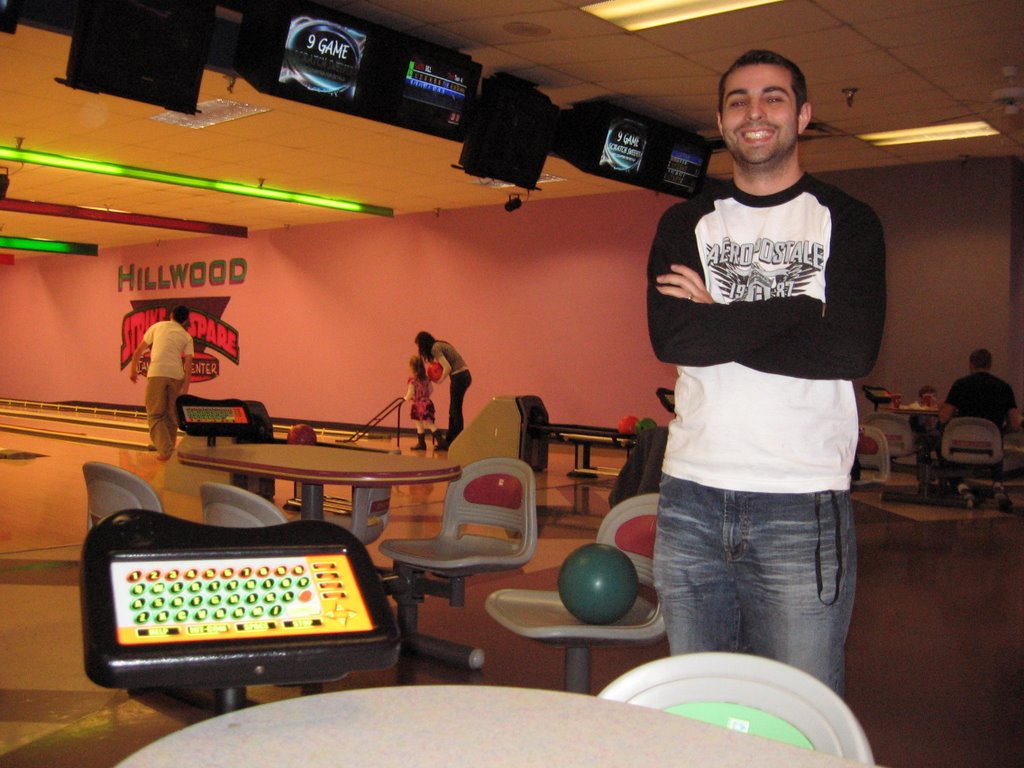
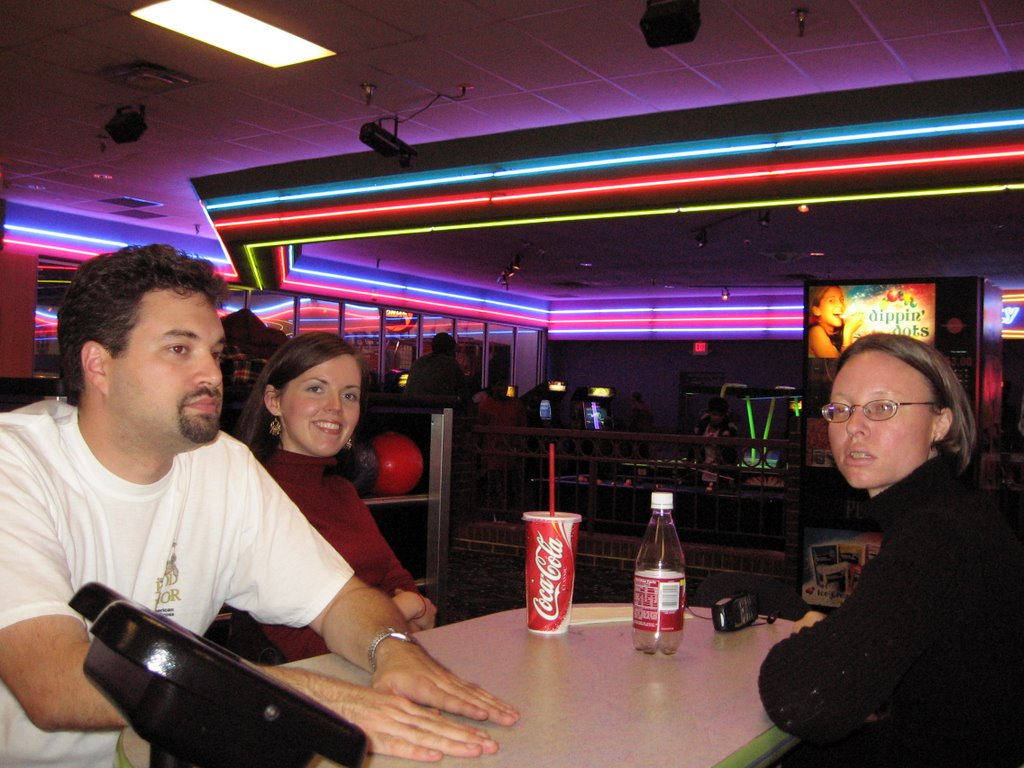
Last Friday night we took a group of six to Hilldale Strike and Spare, a bowling alley west of campus. This was one of our social events that helps us fulfill our commitment to building Christian community among graduate students on campus. I've included several pictures from the evening here.


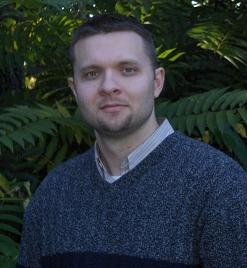
A very satisfied Chris, who just happened to win both games we played that night. Who also just happened to bring his own ball and bowling shoes. Doesn't he look happy?


Alan should look happy. He just bowled his very first 100 point game! Congratulations, Alan!


This is me with Chris' bowling ball. It was an amazing bowling ball. I'm surprised he let me touch it. It glowed with a holy aura of bowling-good-ness.

Looking completely disinterested (or jealous) is Roger.


This is the closest we came to a group photo, but at least it shows our other two companions, Linda and Mary. Since it was close to Halloween, we all chose character names for our bowling. Linda chose "Princess Leia" and Mary was "Pirate." I gave a dollar to Alan who was able to pinpoint which character "Max Rebo" (the name I chose) was in the Star Wars saga. Can you guess it?

Monday, October 23, 2006

Partnering with Local Churches

One of InterVarsity's core commitments is to the local church, and I hold strongly to this commitment myself. If a student were forced, I would by all means tell the student to choose a local church over our ministry. Self-defeating? Maybe, but I'm ok with that.

The problem is that Christ founded the Church, and InterVarsity Christian Fellowship isn't one. We are a support organization, designed to support local churches in their ministry to college campuses. As such, as I go searching for partnership for this ministry, I am aimed at the local church in Nashville.

It's a long process, building databases of contacts and trying to stay up with what other IVCF staff workers are doing in the area. I want to build real partnerships of ministry, and the first step is mutual advertising. I'm constructing a "church book" that will have information on local churches for our graduate students so they can get involved in local churches. I have also prepared Graduate Christian Fellowship ads to be put in local church bulletins and fliers. The free exchange of information will go a long way toward genuine partnerships.

I'm also meeting with a lot of local pastors to get to know them and their ministries. I want to be able to approach them with things down the line that suit their needs and interests. I also want to be able to take volunteers for the ministry on campus.

There is also the remote possibility of moving our small groups into local churches so that a grad student could benefit from GFM's expertise in graduate ministry while being able to plug into a local church during the week. It's an interesting thought I'll have to consider more later.

Please pray that as we move into this new phase of partnership-development, the Lord would work to move the people and places into our orbit that would benefit the people in our care and that, above all, God would be glorified in what we do.

Friday, October 13, 2006

Doctors without Borders

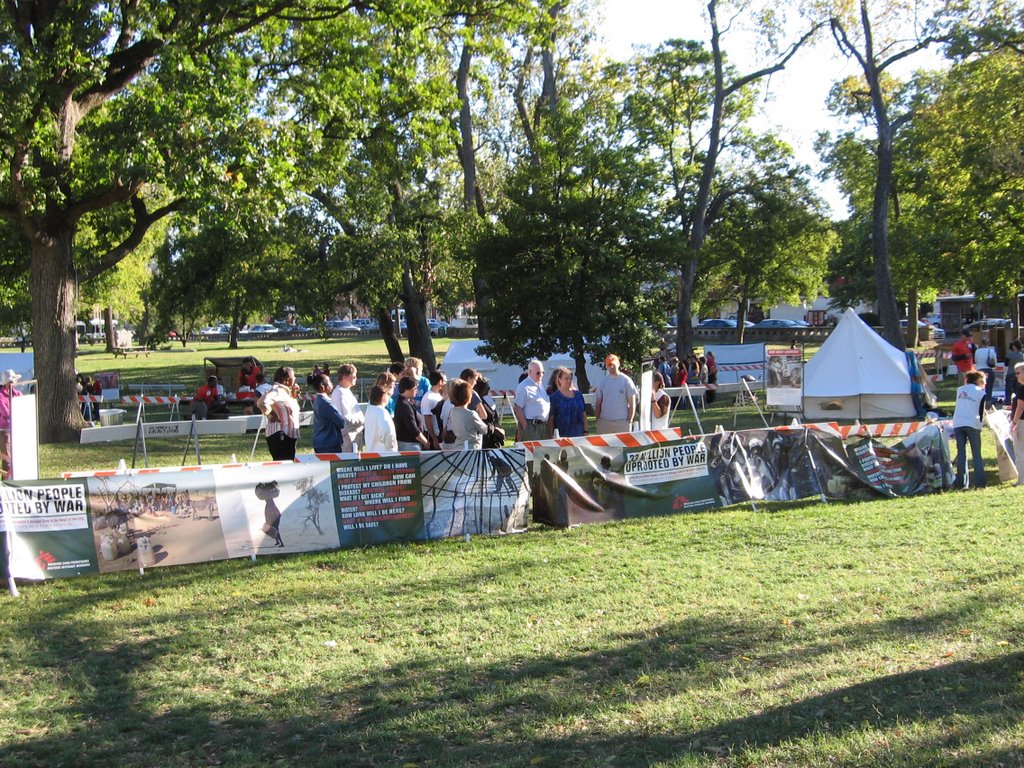
Last weekend, Monique and I went to Centennial Park near downtown Nashville to the Cultural Fair and went to the Doctors without Borders exhibit there. The exhibit itself was a simulated refugee camp that helped us better understand what it was like to live scared for our lives in another country that doesn't want us but has to support us because of international law.

I'll give you some of the highlights of the exhibit. It started on the other side of a guard-rail where it was explained to us that when things get bad in a country torn by war and individuals feel forced to flee their homes, they have no rights in their own country. They might "have" rights in the abstract, but who is going to protect them? Is it the government who's trying to put down an insurgency, or is it the insurgents themselves? When innocent people get caught in the middle of warring parties, rights go out the window ("collateral damage"). If you are being chased by people bent on killing you because of your race or creed, you have to flee the country...

...Because in the next country over, they have to do something about it. According to international treaties, countries must provide refugees with food, water, shelter, and clothing. Needless to say, this is trying on any country who has hundreds of thousands of refugees at a time fleeing over their borders, so many countries (Ethiopia is a good example) close their borders.

Doctors without Borders is an interesting organization because it helps provide medical care for these displaced peoples, the innocent fodder of war. I was impressed by how well human beings can do under such adverse conditions, but I was humbled by the comparative lack they must experience. One example: the average refugee uses 5 gallons of water a day. The average American: 100.

It hit home when one of our touring group (we were led through the camp by a guide) said that she had been in a refugee camp when she was nine. We did the math and found out that she was only a year younger than Monique and I! A Kurd displaced by the first Gulf War, she had to carry those five-gallon jugs of water a mile at a time ("They were heavy," she said, "but we had to do it."), while I was disgruntled that AWANA was canceled the night of the beginning of hostilities and wanted to know why war wasn't like G.I. Joe. I was having a hard time understanding the amazing technology of war shown on ABC news while she was fighting for her life in the dessert. I sat at school while she carried water by the mile.

In these circumstances, Christians cry out from the depth of their souls, "Maranatha! Come, Lord Jesus, come!" With all the evil in the world, and all the sufferers, and our lack of ability to finally fix either one, we can only cry for our Redeemer to return and set everything right again. We give thanks to God for His grace to us in Jesus Christ, and apply ourselves to walk in the path that Jesus pioneered for us, the path of self-sacrificial love for our neighbors nearby and for the little girl carrying water on the other side of the world.

Tuesday, October 10, 2006

Getting Things Done, by David Allen

The book Getting Things Done: The Art of Stress Free Productivity, was suggested to me by my supervisor on Thursday of last week. The way he talked about the book made me immediately curious about what could be so revolutionary about it. It's just a productivity book, eh?

Well, it's the first book on productivity I've read, and it's been an amazing few days. The book introduces a five-step method of "getting things done," one that I'm finding to be extremely helpful.

1. Collect--Put everything, I mean everything, into a physical inbox (electronic in the case of email). The whole point of the system is that you free your brain to do stuff other than remember. So get it all out of your head.
2. Process--Sit down and process everything in the the inbox by asking several questions. Is it an actionable item? If no, then throw it away, file it, or put it aside into a "Someday/Mabye" list. If the item does have an action associated with it, take a couple of seconds to decide the very next physical action required. If the action takes 2-minutes or less, do it. If it will take longer, organize it on one of your lists (step 3)
3. Organize--file non-actionable items, and put action items that will take more than two minutes onto a "Next Action" list, arranged not by topic but by context (i.e., at the computer, online, office, anywhere, home, etc.). There are more lists to be added to that make the system even better, but I won't go into them here.
4. Review--before you go about doing, you have to review. Start with your calendar. If there are items that HAVE to be done that day, do them. Next, move to the "Next Action" list.
5. Do--now, looking at your "Next Action" list, decide based on your context, time, energy, and priorities which item should be done next.

The beauty of the system is that it is "bottom-up." Since everything goes in the inbox, everything makes it in. Therefore, there's no need to worry about trying to remember something. Take two seconds to jot down a note to yourself when something crosses your mind, and drop it in the inbox. It won't be too long until you process the inbox again, and in the meantime you can concentrate on what you're working on.

The three most helpful pieces of wisdom in this book are:
1. Next actions--this is incredibly freeing, taking the time to decide what actually needs to be done next. For example, instead of putting a nebulous "Wedding Gift" on your to-do list, put it in your projects list, and add "Brainstorm gift ideas" into your next actions list. That way you know what you're going to do next, and the brainstorm will spawn another action item like, "Talk to spouse about gift ideas," etc.
2. Two-minute rule--if it takes two minutes or less, do it. Also freeing, this clears away all the clutter so you can focus on the important things. It's also amazing how many household chores take two minutes or less!
3. Inbox--putting everything in my inbox is a great feeling. I know it will be attended to, so I can forget about it and plow ahead in what I'm doing.

So, if you're looking for a way to reorganize your life, pick up Getting Things Done and work yourself through the book. You won't regret it.

Tuesday, October 03, 2006

Driving, Driving, Driving, Flying, and a Proposal

I've returned from my InterVarsity GFM fund-development trip. In my last post, I wrote out the tentative itinerary and promised a report with pictures. Well, here it is.

I started my trip by picking up a Hyundai Sonata from Hertz at the airport. It's cheaper on my budget to rent a car than to expense the mileage for my own, so that's what I did. I wish I had taken a picture of it, because it was a neat little car with a great sound system, working A/C, a sunroof, and a self-darkening rear-view mirror. Ah, the niceties of life, or, err, Hertz.

First stop was Vilonia, AR (383 miles). There, thanks to the generosity of Rhonda Harris and First Baptist Church of Vilonia, I was able to make a presentation to 15 total people. By far the scariest audience I've had (they are, after all, my wife's friends and family), they were warm, encouraging and generous. This picture is of me handing out information before the presentation.


Next stop, Siloam Springs, AR (+200 miles). In Siloam, I stayed with old college friends, Mark and Megan Etter, ate lunch with Kyle and Katie Weaver, toured my alma mater's campus, talked with professors, ate breakfast with an old friend Patrick Carr, and reinvigorated some of the networks I had lost since graduation three years ago. I am hoping to stop back through Siloam soon to make a presentation now that I have reaquainted myself with the area, but I am happy to have garnered some support while I was in town.


Next stop, Stillwater, OK (+155 miles). I had intended to have another dessert presentation while in Stillwater but for various reasons the dessert itself fell through. Instead, I was able to have meals with a couple of families who are going to support me, and, of course, I got to hang out with my family and take my (not-so) little brother Stephen out for coffee (or hot chocolate as the case may be). It was a fun and restful time. Unfortunately, the camera didn't make it out of the bag while I was there.

Next stop, Tomball, TX (+497 miles). There, I was able to attend the church I grew up in both Sunday morning and evening, talk with a few folks about InterVarsity, and stay with two sets of Callons (Ken and Mary, and Craig and Cheryl--the Callons have been close friends of mine since the second grade). I had a similar experience in Tomball as I did in Siloam Springs--I saw a bunch of people I hadn't seen in ages and got to start some of those friendships again. In some ways it's sad that it takes the fund-development process to bring me back into their lives, but in others, I'm so happy to have reason to do so. Being back in Tomball felt like going home, and I realized just how much I missed it.

I left on a Sunday and arrived back in Nashville (+792 miles) the next Tuesday night. By the end of the road trip, I had traveled over 2020 miles in that Sonata. We had become close friends.

On Wednesday, I flew to Philadelphia (+1600 miles round trip) to be with Monique while she defended her dissertation proposal. Defending the proposal is a big deal at U.Penn. because you don't have to defend the final product, just have it signed off by your committee of three. (I guess the figure they want to nip any problems in the bud). The whole department came out to hear Monique's brief presentation and then grill her on the details. Monique handled herself amazingly and her proposal passed without any revisions! Thanks be to God!

Thank you to all of you who were praying during my trip and during Monique's defense! We appreciate it greatly. If you have any other questions about the trip, please feel free to add a comment to this blog or email me. I'm looking forward to hearing from you.

Friday, September 15, 2006

Fund-Development Trip and Upcoming Attractions

FUND DEVELOPMENT TRIP:
I'm leaving Sunday for a 9 day fund-development trip through AR, OK, and TX. I'll be speaking at 2 dessert/coffee socials and meeting people one-on-one to discuss partnership in InterVarsity's ministry at Vanderbilt.

If you know of anyone who might be interested in hearing about InterVarsity's Graduate and Faculty Ministry who lives anywhere along my route, send me an email (jasoningalls@gmail.com) and let me know. I'm hoping to raise approx. 20-25% more of my support on this trip.

Please pray for safety in travel and God's favor in supplying our needs, and keep Monique in prayer as well--she's defending her Ph.D. dissertation proposal Sep 28!

The tentative schedule (right now):
Sun, Sep. 17--Leave Nashville and arrive in Vilonia, AR
Mon, Sep. 18--Dessert/Coffee Social w/ Presentation at home of Rhonda Harris
Tues, Sep. 19--Travel to Siloam Springs, AR, and meet with individuals (and possibly a group in a coffee shop)
Wed. Sep. 20--Travel to Stillwater, OK
Thurs, Sep 21--Dessert/Coffee Social w/ Presentation at the home of Jeff Cathey (hosted by Community Free Church, Stillwater, OK)
Fri, Sep 22--Meet with individuals in Stillwater and Oklahoma City
Sat, Sep 23--Travel to Tomball, TX
Sun, Sep 24-Tues, Sep 26--Meet with individuals in Tomball/Huntsville area
Tues, Sep 26--Travel to Nashville
Wed, Sep 27--Fly to Philadelphia to be with Monique for her dissertation proposal defense

UPCOMING ATTRACTIONS:
I'll start posting several things on the blog after I get back from my trip.
1) A full report (w/ pictures) of the trip
2) More details on our regular ministries at Vanderbilt
3) Profiles of students and leaders in the Graduate Christian Fellowship
4) And the rest of the stuff I have been doing...news updates, book summaries, and comments.

Please keep us in mind the next few weeks.

God bless,
Jason

Monday, September 11, 2006

Minigolfing is fun!

This weekend saw our first social event for the year: minigolfing. We had about 10 people show up, and despite the little bit of rain, we had a great time. (I think I shot the best game of my life!)

One of the Four Commitments of InterVarsity's Graduate and Faculty Ministries is community. Our Grad Christian Fellowship social events help provide a welcoming environment for graduate students who need a time away from the grind of their studies. We hope these events help them reconnect with themselves, with each other, and with God.

Next month, we are taking a day retreat with study, worship, food, and games. Please pray that God uses this offering of ours to His glory and to the encouragement and edification of His people.

Thursday, September 07, 2006

Public Displays of Devotion

This is an interesting post on Touchstone's Mere Comments blog about a Jewish man who was escorted off a plane for praying. If you read the article to which the blog connects, you'll see that there was more to the situation than just religious bias, but the fact that a religious person's prayers made others "uncomfortable" enough to complain to the flight attendants is an interesting sign of our times.

Isn't it interesting that "uncomfortable" is the word used, not "offended"? It sounds like a similar discomfort to the one I feel when I see a couple making out in a movie theater or park, or see a mother breast-feeding (without covering) in public. Making out and breast-feeding are beautiful things (in the proper contexts), but the culture in which I have been raised says that those are "private" things that shouldn't be trotted out before "public" eyes. The classic retort to the couple is "get a room," and I imagine that the same would be said for the mother. "Get a room" equals "find a private space to do that private thing." I wonder if that same "get a room" was being thought for the Jewish man praying.

If that's the case, then there is something deeper against which religious people must struggle in order to enter the genuine tolerance I discussed in my last post. The feeling that comes when people transgress "public" spaces with "private" actions goes far beyond religion and into the deepest part of our society. The questions society has to ask itself are these: "What is private? What is public? And, what overlap can we allow in the middle?"

And I will pray, no matter what society does, that Christians will always have the courage to pray in public for the world in Jesus' name, even if they get escorted off airplanes in the process.

Tuesday, September 05, 2006

"Tolerance" in the Classical Sense

[Under the tag "Comment" I will, well, comment on things I've found interesting. I hope you'll find it interesting, too]

Since Monique and I live about ten miles away from campus, I get to drive back and forth on the busy Nashville roads. Since a lot of that time is spent sitting and waiting for lights to change, I've started downloading podcasts to keep me occupied and thinking. One of these podcasts is the weekly National Public Media offering: "Speaking of Faith".

I find SOF so interesting because its host, Krista Tippett, seems to be an honestly struggling agnostic/spiritualist/secularist. Obviously educated, she embodies the ideas and culture of today's academy towards religion: that is, she genuinely believes that religion is good and helpful and able to articulate truth that science cannot. For that reason, I'll call her a "positive pluralist." That definition is over against what we might call "negative pluralists" of the previous several generations in academia, or more commonly, "atheists."

So, the title link is to an interview Tippett did this week with Eboo Patel, Muslim founder of the Chicago Interfaith Youth Core. What I found so interesting, and worthy of sharing, was that Patel embodied the definition of tolerance that I have heard American evangelicals espousing since "tolerance" became a liberal buzzword (that meant embracing all religions/ideas/lifestyles as equally true or valid). Instead, I and other evangelicals believe that tolerance really means being able to work with people who you really disagree with without losing one's disagreement.

Patel's organization is about bringing teens from different faith traditions together, getting them involved in service projects (such as tutoring or construction work), and then bringing them together to reflect on how their religious traditions effect their service. So, a Muslim might say that the Koran asks Muslims to give alms as part of their religious obligation, while a Christian would point to the example of Christ, the early church, and justification by faith (and so not by works or social standing). In so doing, the teenagers are forced to reflect on their faith in a way that they wouldn't have had the same thing been brought up in youth group.

As a Christian who does not believe that tolerance means embracing all ideas as equally true but instead believes that tolerance means being able to work with people who you really disagree with, I find the space created by Patel's organization (at least as portrayed on SOF) fascinating. Could it be that what we have argued against the liberals for so long has finally been embodied by a Muslim? Interestingly enough, Patel credits the pro-life cooperation of Evangelical Christians with Roman Catholics as an important inspiration for his work. He says at one point in the interview, "I love Evangelical Christians."

So, if you have an hour to kill, listen to the interview online or download it to your desktop or IPod. I'll be interested to hear what other evangelicals have to say on the topic.